When you look at the stars, you are seeing your past.
This was what we really came for, to see the stars at San Pedro. The Lonely Planet guide told about a French astronomer who led star gazing tours, using his own high power telescopes. We signed up at the SPACE agency in San Pedro, and that night, we were driven by bus to the Atacama Lodge. Alain Maury and his wife Alejandra established the lodge in 2003, and lead observations every night, except during full moon periods. We were thankful that when we were there, we were hitting the the tail end of a full moon. We had been warned to dress warmly, which for us meant wearing just about everything we had.
We were so excited we could hardly stand it. Our sailing trip has given us several opportunities to see magnificent night skies, andwe had joined several stargazing tours in the US Virgin Islands. This was different. This was the Southern Hemisphere, and we would be seeing stars we had never seen before. Imagine that for a moment. Think of how old you are, how many times you’ve seen the same stars in the sky, and then think that there’s a totally different night sky with stars you may never see in your lifetime.
After a short ten minute ride, the bus stopped at a very dimly lit house. Stepping off the bus, was like stepping into another universe. The sky! The stars were so close, so bright. There was pitch blackness all around us, then you look up and see thousands of stars, and you can’t move. You are awestruck, amazed, rooted to the spot, even a bit dizzy. The Milky Way,( at best seen to most Americans as a small band of stars) blazes across the sky, a thick band of white, from one end of the horizon to the other. You can’t take your eyes off it. Fortunately, Alejandra is there to greet you and help you move along into a candlelit room in the lodge. While our eyes adjusted to the light, preparing ourselves for the outside star gazing, Alain gave us a history of the lodge and a brief introduction on what we would be seeing outside. Alain is French and came to Chile because as he says, “There are more stars in the southern sky.” He married Alejandra and from their passion came the Atacama Lodge, where they give the sky tours.
After a brief explanation of what we would be seeing our group headed outside. Alain used a laser pointer and a good bit of humor to point out the different stars, planets and constellations. He encouraged us to get a closer look through the several large telescopes scattered around the yard. Each telescope was aimed at a different part of the night sky. These aren’t your average telescopes. Alain has teh largest group of telescopes in any public observatory in South America. and they are big, between 20 an d60 centimeters in diameter. The telescopes are so powerful, making the stars so clear, you almost can’t believe what you are seeing. One telescope, pointed at Saturn, clearly showed the rings and all the vibrant colors. In fact it was so clear, it seemed fake! Tessa and Tristan were blown away by what they saw. They (we) were so excited, going from telescope to telescope, asking each other, “Did you see that?”, “Did you see that?” You ask yourself, how have these stars been here all this time and I’ve never seen them. Amazing. We saw distant galaxies, star clusters, blue, red, yellow, turquoise, green stars. I never knew stars came in so many colors. Alain’s enthusiasm never let up, as he and Alejandra patiently answered questions and aligned the telescopes to show us different parts of the sky.
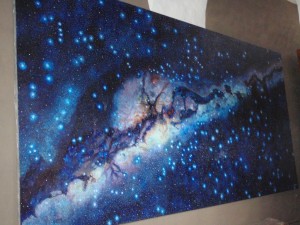
Without a doubt, the Milky Way was my favorite. Nearly every ancient civilization has some history with the Milky Way. The Incas and Mayans in particular, viewed it as a link from the upper world to the lower world, with some civilizations believing we were born or created through the Milky Way. Looking at the Milky Way, it’s not just the stars you can see that are important, the lack of stars, or blackness, is equally revered. The Incas saw animals, such as the Llama, snake, toad swimming in this celestial river. We had seen pictures of what it looked like but never saw it ourselves, until in the middle of the Alain’s presentation Tristan whispers to me “I can see the Llama in the Milky Way.” And you easily could.
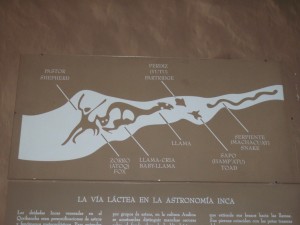 This picture, taken at a museum in Cusco shows the animals the Incas saw in the Milky Way.
It was cold out, and even with all our layers we were starting to feel it. When he felt everyone had gotten a good view through the telescopes, we went back inside the lodge. While Alejandra served the best hot chocolate I’ve ever had, Alain told us more about the night sky and answered questions. Some things he told us were obvious, but made you think.
For example, there are no shooting “stars”. They are dust particles or debris burning up in our atmosphere.
The night sky shows the past, stars that have been there for a long time and may not be there now.
And a big surprise to me, all stars are suns, with the possibiltiy of having their own planets, something that Alain is interested in finding.
We could have listened to him talk for hours, but it was time for our tour to end, and the next one to start. Back at our hotel, we again ended our day reliving our experience around a blazing fire. Life couldn’t get any better.

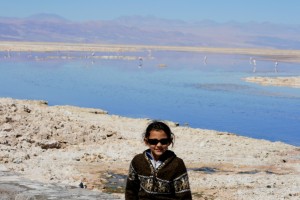 You know we didn’t know what to expect from San Pedro. We had come for the stargazing actually, but were amazed at how much we loved the town and the desert itself, and of course the volcanoes! For me, there is an immense feeling of joy and wonderment when I see these magnificent snow topped volcanoes towering above the flat plains. You can feel how powerful they are from miles away. There are so many options for tours here. We had thought about the tour to see the geysers, but that involved an all day commitment, starting at 5:30 am. We just couldn’t work up the enthusiasm for waking that early. San Pedro encourages a slower pace, so we opted for the tour to the Reserva Nacional Los Flamencos.
 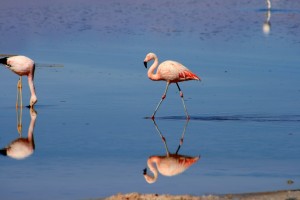 James and Andean Flamingo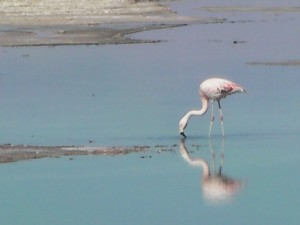
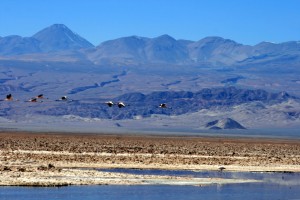 The flamingos make their home on these remote salt ponds and are protected by the national park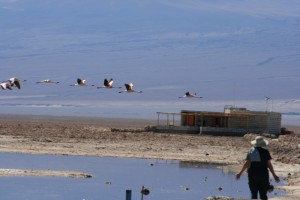
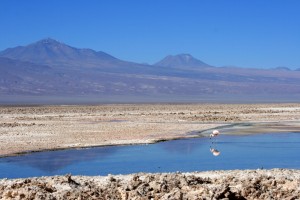
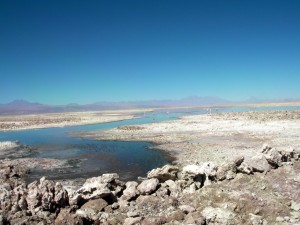 The white you see is the salt. It’s very thick and crunchy underfoot.
 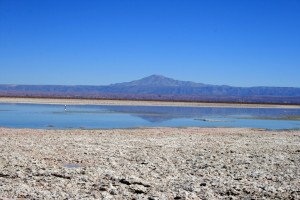 Volcano in the distance, reflecting off the lake
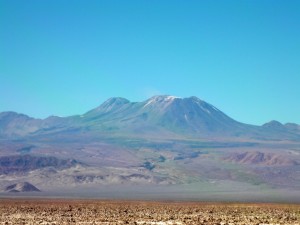 Ojos del Salado, Chiles highest peak at 22,614 FEET! It’s the highest active volcano in the world. If you look carefully you can see the steam coming from it’s smaller peak.
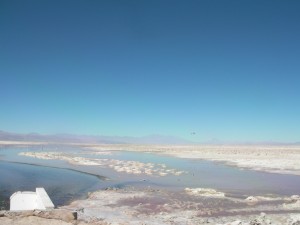 Notice the shades of blue in the sky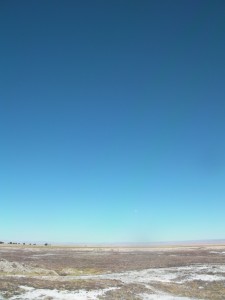
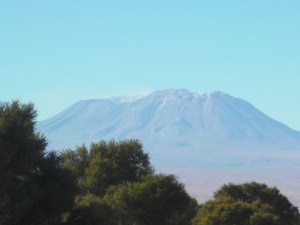 Look close for the steam coming from the left top of the volcano.
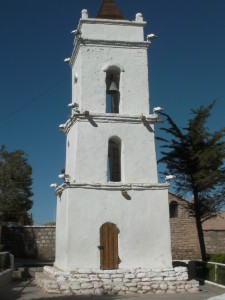 Iglesia San Pedro built in late 17th century
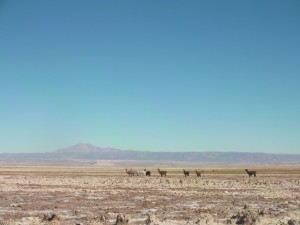 Vicuna
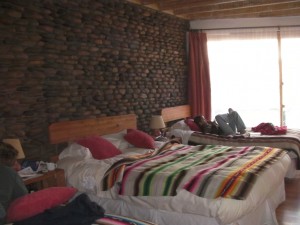 Back to our wonderful hotel room